Issues in, pull requests out
Label an issue factory or comment /factory. Only logins on the policy’s allowed list can start work. Everyone else’s text is recorded and never acted on.
Lumbridge Build
Gated · opens on November 13, 2026Lumbridge Factory turns an issue into a pull request. A coding agent builds the change in a sandbox on its own branch, and nothing is ready until CI passes on that exact commit and a second agent has reviewed it. Then a person merges. It is for teams that want agents working through a backlog without giving them the keys to main.
Tour
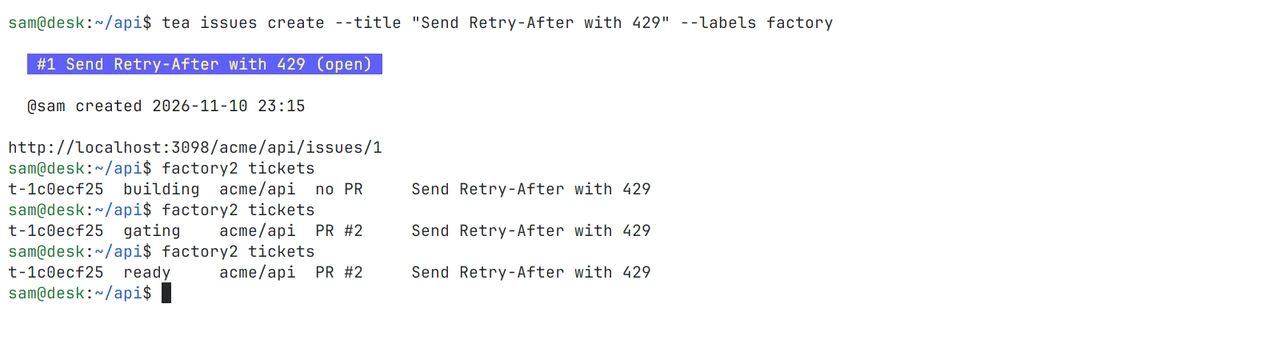
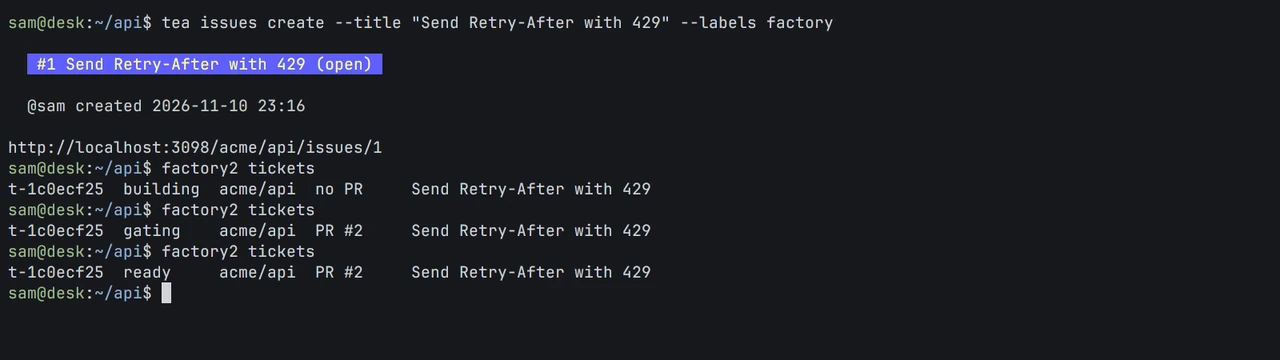
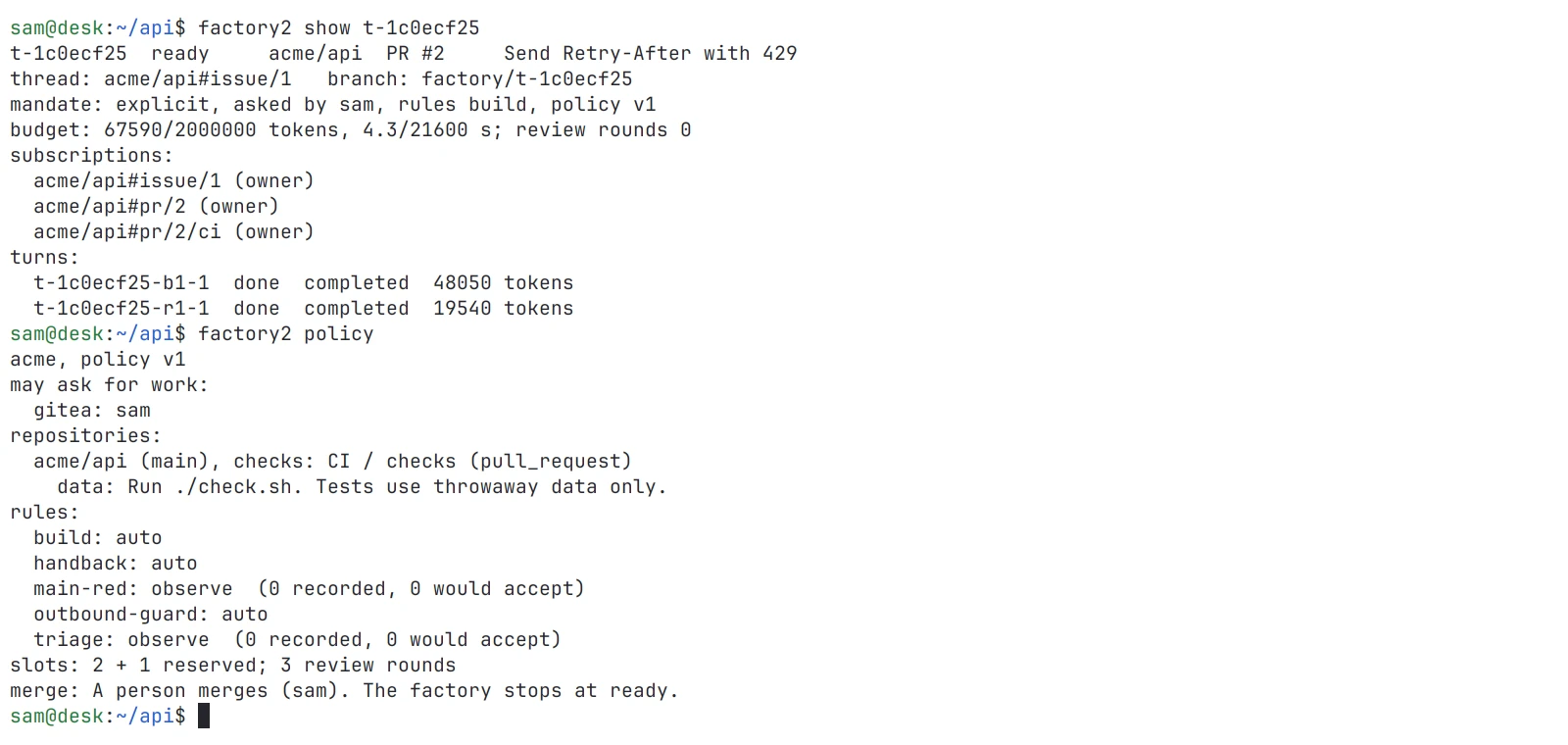
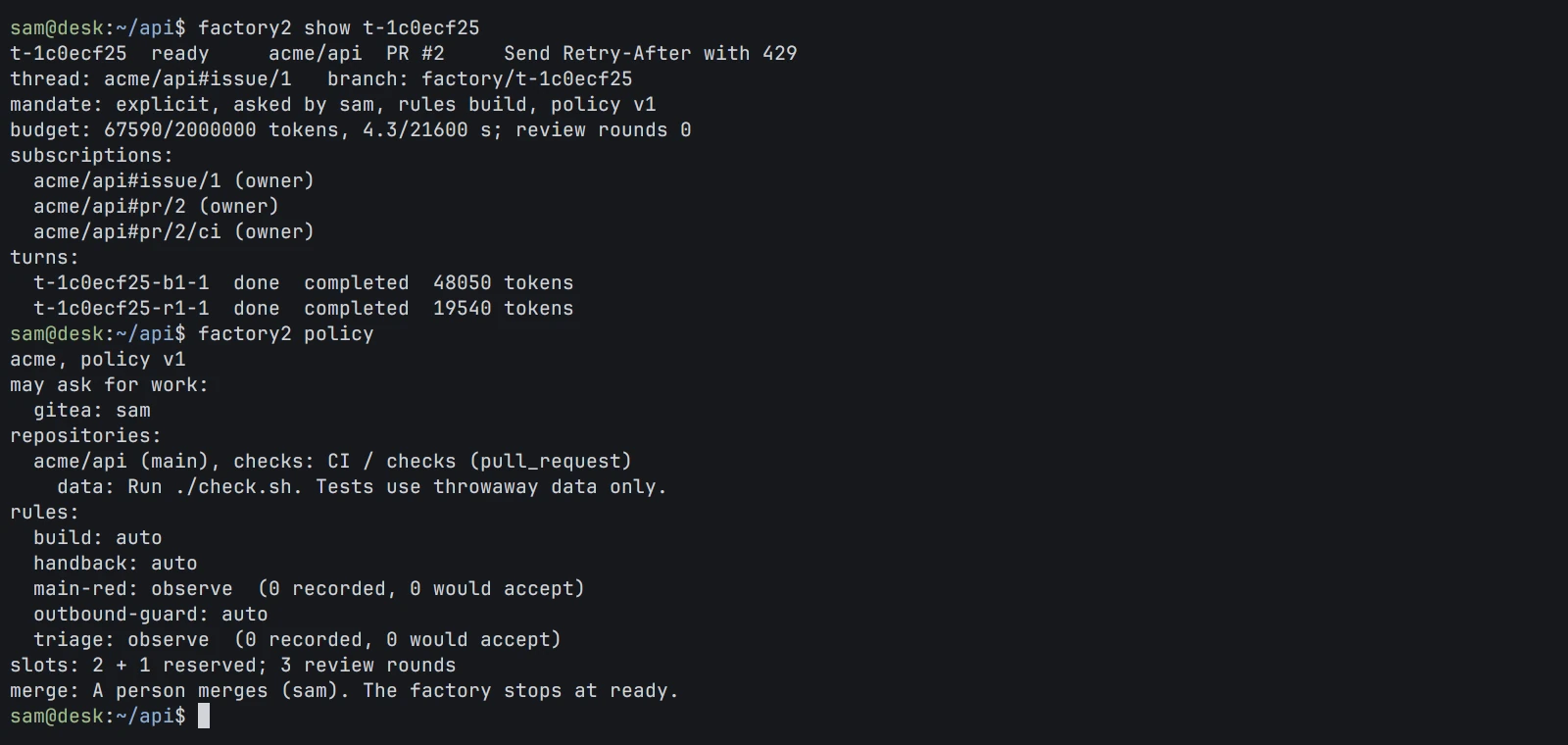
The factory2 command
show prints a ticket's branch, budget and turns. policy prints who may ask for work, the required checks and who merges. Shown in both themes.
01 · What it does
Label an issue factory or comment /factory. Only logins on the policy’s allowed list can start work. Everyone else’s text is recorded and never acted on.
A change is ready only when every required check is green on the head commit, a reviewer has passed that same commit, and the branch contains today’s main. A new commit starts the gates again.
A red check or a changes_requested review wakes the same builder session with the failing log or the findings. After three review rounds it stops and asks a person.
Agents run as their own unix user behind a default-deny network allowlist. They hold no code host token. Their git key can push only factory/* branches, and a hook refuses reads of secrets.
Kill either daemon or reboot the host. A turn still running is reattached, a finished one is collected, and a cut-off one resumes the same session with a recovery note. No comment is posted twice.
Each ticket has a token budget and a wall-clock budget. Reaching one asks a person; it does not kill the work. Slots are held only while a turn runs, and account limits make turns wait, not fail.
02 · How it works
The part that decides and the part that runs agent code are separate processes under separate users. Neither can read the other’s secrets.
Polls the code host, makes tickets, schedules turns, reads the gates and posts comments. It is the only writer of a SQLite store. Every outside effect is stored first and carried out after commit with an idempotency key.
Prepares a git worktree per ticket and runs each agent turn as a fresh headless process. It keeps no ticket state. factoryd talks to it over one unix socket, and only factoryd’s user may connect.
The builder reports through a small MCP tool server: report, reply, handback, recall. Its word is a claim that factoryd re-checks. The reviewer is a different session in a read-only worktree pinned to the commit.
One document names who may ask, each repository with its required checks and CI runner, data rules, outside-action rules, the merge policy, slots and budgets. factoryd refuses to start if a part is undecided.
03 · Use it
Each daemon reads one JSON config. The policy is installed from factoryd.json on a new store and changed afterwards with factory2 policy.
# as the factory user, then as the control user
python3 -m factory2.agentd   --config /etc/factory2/acme/agentd.json
python3 -m factory2.factoryd --config /etc/factory2/acme/factoryd.json

export FACTORY2_DB=/var/lib/acme-control/factory.sqlite3
factory2 policy add-repo acme/api --runner acme-ci --check "CI / checks (pull_request)"
factory2 policy allow gitea dana
factory2 policy slots 2

factory2 status
factory2 tickets --all
factory2 show t-ccd41800
factory2 hold t-ccd41800 --release
factory2 --json status
04 · Docs
These pages are in the repository and open with it. Until then, the Guide covers the same ground and is readable now.
The domain model, a ticket’s life from accept to merge, the three gates, capacity, reliability and the security rules.
Its config file, how a turn stops, the tool hook, and a plain list of what the hook cannot stop.
The socket, every operation, turn idempotency, session ids and the eight turn outcomes.
The factoryd.json and agentd.json keys, with two complete instance examples in instances/.
Step-by-step install logs with an undo beside every step: users, egress, bots, branch rules, CI runner and units.
Scripts that prove what each user can reach and that the bot cannot push or merge main.
Read the Guide chapter: Factory and modelsRequest access to the repository
05 · Works with
factory label, and that starts a ticket.instances/.Not yet
Questions
It is the second version of the factory, and the command, its modules and its config paths still carry that name. The product and the repository are Lumbridge Factory. A lumbridge-factory command will replace it; until then the commands on this page are the real ones.
Claude Code today, headless, one process per turn. Builder and reviewer models are set in the policy with builder_model and reviewer_model. A Codex adapter is in the tree, but it is off by default and has not run a real turn.
Three layers. A server-side pre-receive hook lets the factory’s bot push only factory/* branches and no tags. The branch rule on main has a merge whitelist of people. A tool hook on the agent refuses the obvious attempts before they run.
A red check goes back to the same builder with the log tail. A transient error is retried three times. A cut-off turn resumes with a recovery note, and five cut-offs in a row become one question to a person. A ticket never hangs silently.
Gitea, including Gitea Actions for CI. The source, the comment channel and the gate reads sit behind interfaces, but only the Gitea ones are written.
Apache-2.0. The repository opens on November 13, 2026.
Self-host it, or talk to us about setting it up with you.